

How to accept USDT and crypto payments in WHMCS
12 min read · By the Shroti Host team, founded by Priyanshu Shroti
Short answer: WHMCS ships one crypto gateway, BitPay, a third-party processor that takes one-time payments only. Any other route, including USDT to your own wallet, needs an added gateway module or manual recording. The main choice is who receives the money: a processor that collects it and pays you out, or your own address with a module that checks the blockchain before it marks the invoice paid.
This guide is for a hosting business that runs WHMCS and wants to accept crypto payments in WHMCS, usually because customers abroad ask to pay in USDT or because card payments fail for them. It explains the two ways to do it and the decisions to make first: networks, quotes, short payments, confirmations and refunds.
We make a WHMCS crypto gateway ourselves, so we have an interest here. Everything before the last section applies whichever tool you pick.
What does WHMCS support for crypto out of the box?
WHMCS includes one crypto gateway: BitPay. The WHMCS BitPay documentation lists it as a third-party gateway that supports one-time payments and does not support recurring payments, refunds or reversals from inside WHMCS. It needs a BitPay account and the GMP or BCMATH PHP extension.
The only other built-in route is manual. WHMCS says its Bank Transfer module is open source and can be duplicated to offer more than one offline method, and that you must add each payment by hand. For crypto that works like this:
- Duplicate the Bank Transfer module and name the copy, for example, "USDT (TRC20)".
- Put your wallet address and the network name in the payment instructions.
- Ask the customer to send the transaction ID in a ticket.
- Look the transaction up on a block explorer, check the address, token, amount and confirmations, then use Add Payment on the invoice.
The manual method costs nothing and suits a handful of crypto invoices a month. It breaks down when customers expect activation at night without waiting for you.
Payment processor or your own wallet: what is the difference?
The difference is who receives the customer's coins. With a custodial payment processor, the customer pays an address the processor controls, the processor tells WHMCS the invoice is paid, and you get the money later as a payout, in crypto or in your bank currency. With a direct-to-wallet gateway, the customer pays an address you control and the module only reads the public blockchain to see whether the payment arrived.
There is a middle group: services that call themselves non-custodial but still need a merchant account and API keys, because their servers watch the chain and send WHMCS the callback.
A processor takes on work (many coins, conversion to fiat, sometimes compliance checks) and charges for it. Read its fee page, payout minimums and account terms yourself, because they differ and change. Direct to wallet removes the processor and its account risk, and leaves the custody, bookkeeping and exceptions with you.
| Question | Payment processor | Direct to your own wallet |
|---|---|---|
| Who holds the coins after payment | The processor, until it pays you out | You, from the moment the transfer confirms |
| Account needed | Merchant account, often with business verification | None with a processor. You need wallet addresses and usually blockchain API keys |
| Who decides the invoice is paid | The processor's callback to WHMCS | A module on your server that checks the chain itself |
| Conversion to bank money | Often offered | Your job, through an exchange you choose |
| Costs | Processor fees, plus payout or conversion fees where they apply | Module cost, plus network fees the customer pays to send |
| Refunds | Some offer a refund tool. Check the terms | Manual: you send a new payment |
| Main risk | Account freeze, payout delay, a faulty callback | Losing your wallet keys, and handling exceptions yourself |
Which coins and networks should you offer?
Offer the fewest coins and networks your customers really ask for, because each one is a separate address and a separate way for a payment to go missing.
USDT is not one thing. Tether lists it on many separate blockchains, including Ethereum (ERC20) and Tron (TRC20), and a USDT balance on one network cannot be spent on another. The network decides three things for you:
- The fee the customer pays to send. Network fees differ between Tron, Ethereum and others, and they move with network load. Check current fees before you choose.
- How long you wait. Each network produces blocks at its own pace and has its own point where a transfer is considered final.
- What happens to a wrong-network transfer. Ethereum-style addresses (starting 0x) are valid on several other networks. If a customer sends USDT on one of those to your Ethereum address, a gateway watching Ethereum never sees it. Whether you can recover it depends on whether you hold the keys for that address on the other network, or on your exchange if it is an exchange deposit address.
Many customers pay straight from an exchange. Exchanges charge a withdrawal fee and often set a minimum withdrawal, so a customer who types the invoice amount may send you that amount minus the fee, and a small invoice may be below the minimum. Decide whether your quote will include that fee, and show the network name next to the address.
How is the invoice amount converted, and how long does the quote hold?
A crypto gateway turns the invoice total into a coin amount at a live market price and then holds that amount for a fixed window, often somewhere between a few minutes and an hour. Find out where the price comes from and what happens when that source is down.
If your invoices are in INR or EUR and the customer pays in USDT, two conversions are involved: your currency to US dollars, and dollars to the coin. WHMCS keeps its own exchange rates, which the Currencies documentation says can update daily from the European Central Bank feed. Ask which rate your gateway uses.
The quote window is your protection against price movement. Bitcoin's price can move within an hour, so a long window shifts that movement onto you. USDT is designed to track the US dollar, but it is a privately issued token and the peg is not guaranteed. The value can also change between the day you receive coins and the day you convert them. If you need a fixed amount in your bank currency, convert promptly or use a processor that settles in fiat.
What happens with underpayments, overpayments and late payments?
A gateway can detect a wrong amount but cannot fix it, so write your policy before the first one arrives.
- Underpayment. Usually an exchange withdrawal fee taken from the amount. Ask for the balance as a second transfer, credit a partial payment, or accept shortfalls up to a limit you set.
- Overpayment. Credit the invoice and add the excess as account credit in WHMCS, or send it back. Say who pays the network fee for a return.
- Late payment. The customer pays after the quote expired. Decide whether you honor the old quote and for how long.
- Payment to an invoice that is already paid, or with no invoice at all. Keep a list of unmatched deposits and resolve each one by ticket.
A payment that does not match exactly should be held for a human, never credited by a guess.
How does a direct-to-wallet payment get confirmed?
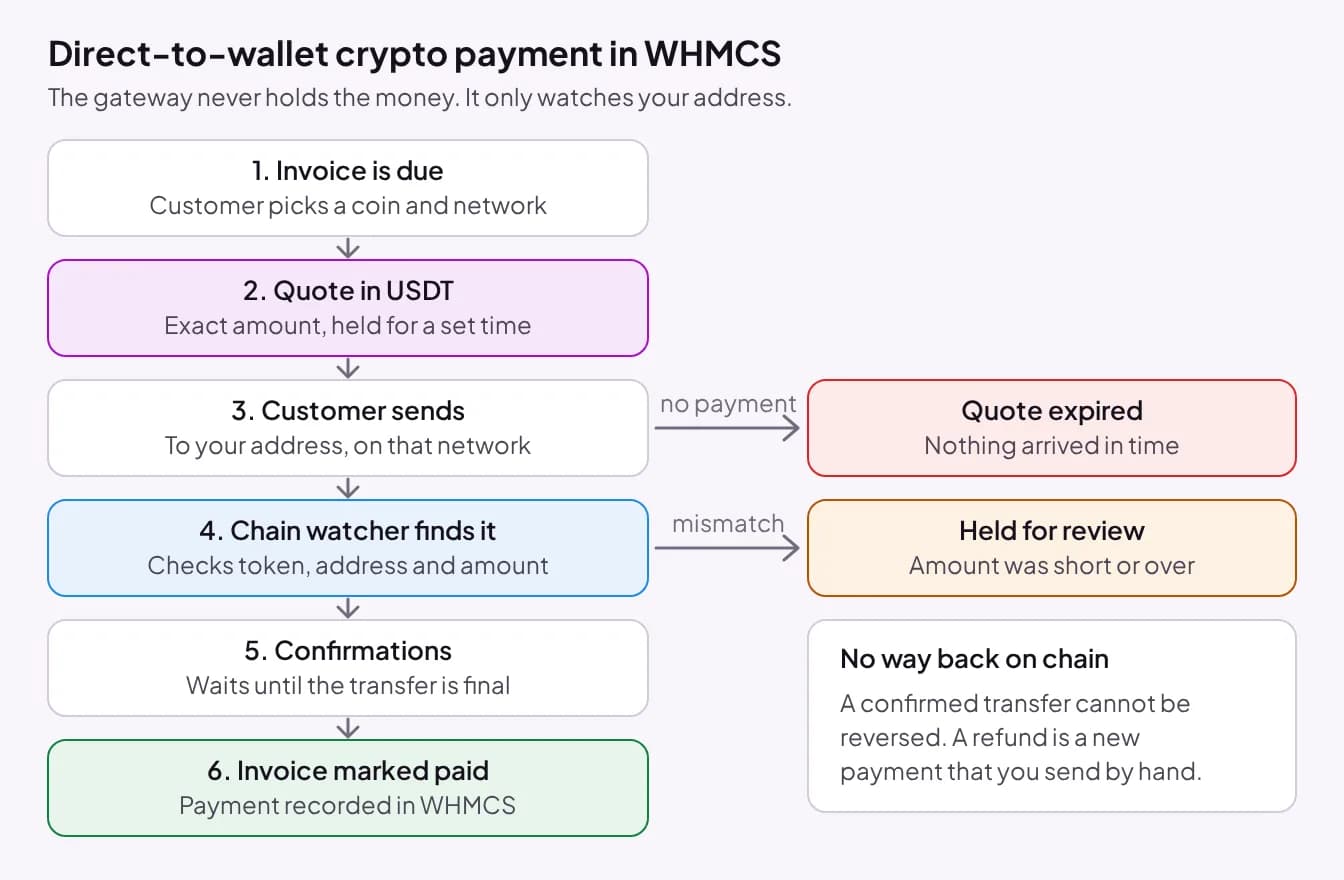
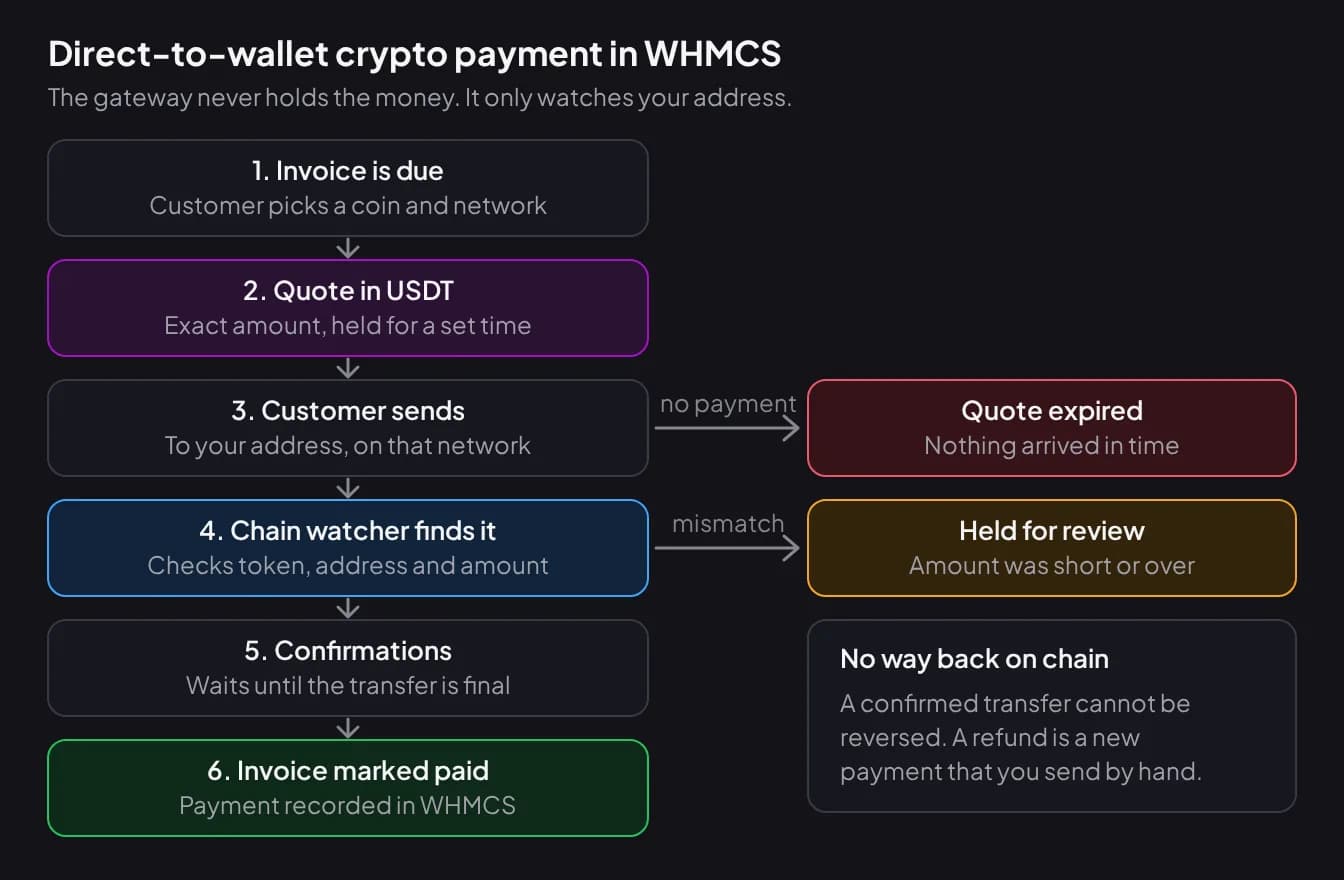
A direct-to-wallet gateway confirms a payment by reading the blockchain: it looks for a transfer of the right token, to your address, for the quoted amount, and then waits for a set number of confirmations before it marks the WHMCS invoice paid. A confirmation is one more block added on top of the block that holds the transaction. Each one makes it less likely that the network drops the transfer.
The number of confirmations is a trade between speed and safety, and it is yours to set. Fewer confirmations activate the service sooner. More protect you from provisioning for a payment that later disappears. Wait longer for anything you cannot take back, such as a domain registration.
Two checks matter as much as the count. The gateway must verify the token contract, because anyone can create a token named USDT. And it must verify the transaction itself on the chain rather than trust a message that says a payment happened.
Refunds, bookkeeping and tax
Crypto payments cannot be reversed, so there are no chargebacks and no automatic refunds. A refund is a new transfer that you send by hand. Decide whether you refund in crypto (which amount: the coins received, or the invoice value at today's price) or as account credit, confirm the return address and network with the customer in a ticket, and state who pays the network fee.
For your books, record for every payment: the invoice number, date and time, coin and network, amount received, the exchange rate used, the value in your accounting currency, the transaction ID, and what you later did with the coins.
Rules for crypto and its tax treatment differ by country and change often, and this article is not legal or tax advice. For India we can point to two official documents only. In a March 2023 reply to Parliament, the Ministry of Finance said crypto assets were unregulated in the country at that time, while transactions were subject to laws including the Prevention of Money Laundering Act, 2002 and the Income-tax Act, 1961. The memorandum to the Finance Bill, 2022 proposed a 30% tax on income from the transfer of a virtual digital asset and a 1% tax deduction on payments for such transfers.
Both documents are old, and neither says how a business that receives USDT for hosting should value, invoice or report it. Confirm the current position with a chartered accountant first.
How Crypto Pay for WHMCS handles this, and where it is not the right choice
Crypto Pay for WHMCS is our direct-to-wallet gateway: it quotes an exact amount, watches your own receiving addresses and credits the invoice once the transfer is verified and final. It is one of the WHMCS modules in our store, on sale from 1 December 2026 at ₹199 a month or ₹1,999 a year, or ₹5,999 one time for a lifetime license that includes one year of updates and support (excl. service fee).
- Networks: five, each switched on separately. USDT on Tron (TRC20), USDT on Ethereum (ERC20), Bitcoin to legacy addresses, Bitcoin to SegWit and Taproot (bc1) addresses, and BBTC (Binance Wrapped BTC) on Ethereum, which is neither native bitcoin nor WBTC.
- Rates: priced from CoinGecko first, with the Binance ticker as fallback, cached for 60 seconds. If no live price is available, no quote is issued. The quote is held for 15 minutes by default (5 to 120).
- Matching: one address per network serves every invoice, so each quote gets a unique exact amount and the customer must send exactly that. There are no per-invoice addresses and no HD wallet support.
- Confirmation: transactions are found through TronGrid, Etherscan and mempool.space and each is verified again before credit. The default is 3 confirmations (1 to 30), Ethereum never uses fewer than 12, and Tron also waits for an irreversible block.
- Wrong amounts: transfers between 50% and 200% of the quote, payments on paid invoices and unmatched deposits are held in a review queue and emailed to admins. The exact amount is watched for 48 hours by default.
- Exchange fees: you can add a fixed withdrawal fee per network to the quote. Live fees come from Binance's public list only, and that setting is meant for merchants whose addresses are Binance deposit addresses.
- Requirements: WHMCS 9.x (tested against 9.1 only), PHP 8.1 to 8.4, ionCube Loader 15 or later, the bcmath, curl, json, mbstring and sodium extensions, the WHMCS cron every 5 minutes, a free TronGrid API key for USDT TRC20 and an Etherscan API key for USDT ERC20 and BBTC. Bitcoin needs no key. After activating the gateway you also activate its console addon and complete the Setup tab.
The limits are real. Its own documentation tells you to send one small real payment on each network before you offer it to clients, and you should: this release was tested in a WHMCS 9.1 test environment and has not been tested with real money on any network. It depends on the third-party services named above, and a network whose provider is down is not offered until it recovers. It does not send refunds, convert to fiat, screen for sanctions or KYC, or produce tax reports. It does not support BEP20, Polygon, Solana, Lightning, USDC or native ETH.
Choose a processor instead if you need settlement in your bank currency, compliance screening, or coins and networks outside that list. Stay with the manual method for a few crypto payments a month. For customers in India, UPI is the more familiar way to pay. For USDT or Bitcoin paid straight to addresses you control, see the Crypto Pay requirements and setup steps. If you are still setting up the business, read our guide to starting a hosting business in India.
Frequently asked questions
Can I receive crypto in my own wallet from WHMCS without a processor account?
Yes, in two ways. You can duplicate the WHMCS Bank Transfer module, show your wallet address and record each payment by hand with Add Payment. Or you can install a direct-to-wallet gateway module that watches your address on the blockchain and marks the invoice paid after the transfer confirms. Such modules usually still need free API keys from blockchain data providers.
Should I accept USDT on TRC20 or ERC20?
Offer the network your customers already hold USDT on, and ask a few of them before you decide. Network fees and confirmation times differ between Tron and Ethereum and change with network load, so check current fees. You can offer both, but each network needs its own address, and the checkout must show the network name clearly to prevent wrong-network transfers.
Can WHMCS take recurring crypto payments?
Not automatically. An ordinary blockchain transfer is started by the payer, so a gateway that only watches an address cannot pull a renewal the way a card subscription does. WHMCS lists its built-in BitPay gateway as one-time only. In practice the customer pays each renewal invoice by hand, or keeps account credit in WHMCS that renewals draw from.
Can a customer charge back a crypto payment?
No. Once a transfer has enough confirmations, the sender cannot reverse it and there is no card network or bank to file a dispute with. That protects the host from chargeback fraud. It also means a customer who is owed money back depends entirely on you sending a refund by hand, so publish a clear refund policy.
Is it legal to accept crypto for hosting in India?
We cannot answer that for your business. In March 2023 the Ministry of Finance told Parliament that crypto assets were unregulated in India while transactions remained subject to laws such as the Prevention of Money Laundering Act and the Income-tax Act. Rules and tax treatment may have changed since. Ask a chartered accountant before you enable a crypto gateway.
Does a direct-to-wallet gateway need my private key or seed phrase?
It should not. Watching for incoming payments only needs your public receiving address, because anyone can read the blockchain. A private key or seed phrase is needed only to spend. Crypto Pay for WHMCS never asks for one. Treat any module or service that asks for a seed phrase as unsafe, and keep your keys off the web server.
What should I do if a customer sends USDT on the wrong network?
First find the transaction on that network's block explorer to confirm where it went. If the address is in a wallet whose keys you hold and the network uses the same address format, you may be able to reach the funds by adding that network to your wallet. If it is an exchange deposit address, only the exchange can help, and it may refuse or charge a fee.
#whmcs#crypto-payments#usdt#payment-gateways
See Crypto Pay for WHMCS
USDT and Bitcoin paid to your own addresses and checked on chain before the invoice is credited. On sale from 1 December 2026, from ₹199/month excl. service fee.